
目次

When looking for a pre-owned Hermès bag, it's natural to feel anxious about whether you can choose an authentic one. While it's often thought that you can judge authenticity just by looking at engravings or stitching, there are sophisticated counterfeits, making it risky to determine authenticity based on a single feature.
To avoid making a mistake, it's best to check the consistency of engravings, materials, stitching, hardware, and construction in photos, and additionally consider the product description, appraisal system, and return/guarantee conditions. This article provides an easy-to-understand guide for a helpful pre-purchase self-check.
Judge not only by engravings, but by multiple elements and the seller
When distinguishing Hermès bags, the first thing to remember is that you cannot simply say "it's authentic because it has an engraving" or "it's authentic because the stitching is slanted." The appearance changes depending on the manufacturing year, model, material, repair history, and usage condition, and the impression also differs based on photo lighting and resolution.
Before purchasing, look not only at the brand engraving and manufacturing date code, but also at whether the leather texture, stitching and edges, hardware shape and movement, and the structure of the interior and pockets connect naturally as a single bag. Even if you notice something unusual, do not immediately assume it's fake; ask for additional photos and explanations.
The final decision is supported by the seller's appraisal system and post-purchase support, as they have actually examined the product. While photos are useful for comparison, there are limits to self-judgment based solely on images. It is important to choose a seller who meticulously discloses product information and can answer inquiries specifically.
Four checking points: Engravings, Material, Stitching, and Hardware
1. Engravings|Look not just at the text, but also at the position and surrounding condition

Some Hermès bags feature brand stamps and stamps related to the manufacturing period and craftsmen. The stamp indicating the manufacturing year varied in format over time; before 2014, alphabets were enclosed in a circle or square, but from 2015 onwards, unenclosed alphabets became the norm. A letter like "K" in the photo indicates the manufacturing year, and accompanying letters or symbols like "BY" are considered internal codes for managing craftsmen and ateliers.
In photos, check how the engraving is impressed into the leather, whether the surrounding grain and color, and stitching are unnaturally disconnected. Faintness or blurring can occur due to use or shooting conditions, so if it's hard to read, request magnified photos and confirm with the seller whether it is consistent with the year, material, color, and hardware described in the product description.
The formats of date codes by era are as follows:
~1970: Unenclosed alphabet
- Features: During this period, the alphabet indicating the manufacturing year was stamped without a frame such as a circle or square.
- Craftsman stamp: In addition to the manufacturing year stamp, some items may feature letters, numbers, etc., used to identify craftsmen or ateliers.
1971-2014: Circle frame and square frame era
- Features: From 1971, alphabets enclosed in a circle were used to indicate the manufacturing year, and from 1997, alphabets enclosed in a square were used.
- Arrangement: Letters or symbols for identifying craftsmen or ateliers may be stamped near the manufacturing year stamp.
2015-present: Return to unenclosed stamps
- Features: From 2015 onwards, the circle and square frames were abolished, and the format changed to unenclosed alphabets indicating the manufacturing year.
- Arrangement: The alphabet indicating the manufacturing year may be accompanied by letters or symbols used to manage craftsmen or ateliers.
2. Material|Look for consistency with the product description, not just "looks like genuine leather"

Togo leather is characterized by its grained texture and moderate suppleness, while Veau Epsom features a fine pressed grain and a texture that maintains its shape well. However, natural leather has individual differences, and the surface appearance can change due to scratches, dryness, cleaning, and photographic lighting. It cannot be judged by a single item such as "large grain" or "strong luster."
The important thing is to check whether the stated material is consistent with the bag's overall firmness, how the corners are formed, how it folds, and the texture of the interior. By checking not only the front but also the sides, bottom, corners, and interior, it's easier to grasp the material's expression and condition of use in a three-dimensional way.
3. Stitching and Edges|Look not only for uniformity but also for adherence to the structure

When discussing Hermès stitching, the angled stitches characteristic of hand-stitching often draw attention. However, the appearance changes depending on the stitching location, leather thickness, presence of repairs, and photographic angle. One cannot rely on a simple distinction like "slanted means authentic" or "straight means fake."
In photos, check if the stitching follows the contours of the bag, if the thread isn't excessively loose, and if there are no unnatural finishes at the corners or handle bases. For the edges, their thickness, cracking, and presence of re-coating also serve as clues for condition assessment. Compare both sides to ensure the finish is structurally sound.
4. Hardware|Check not just the shape of the engraving, but also the assembly and movement

The turn lock, feet, zipper, and strap hardware are areas where both appearance and function should be checked. Beyond color and engravings, looking at the size relative to the bag body, attachment position, alignment, and movement of movable parts provides more information.
Minor scratches and dullness on pre-owned items are often natural changes due to use. Conversely, a strong luster isn't necessarily a good sign. If repair or replacement history is available, compare it with the description, and if you're concerned about catching or looseness during opening/closing, requesting a video or additional explanation will provide peace of mind.
Birkin|From overall balance to consistency of details

For a Birkin, you'll want to check the front flap, belts, turn lock, handles, and feet as a single structure. Instead of just looking at the stitching and edges, check that the left-right balance, the tension of the leather, the position of the hardware, and the interior are consistent with the product description. For pre-owned items, it's important to view the condition three-dimensionally, including any loss of shape or scratches from use.
View Hermès Birkin product listings
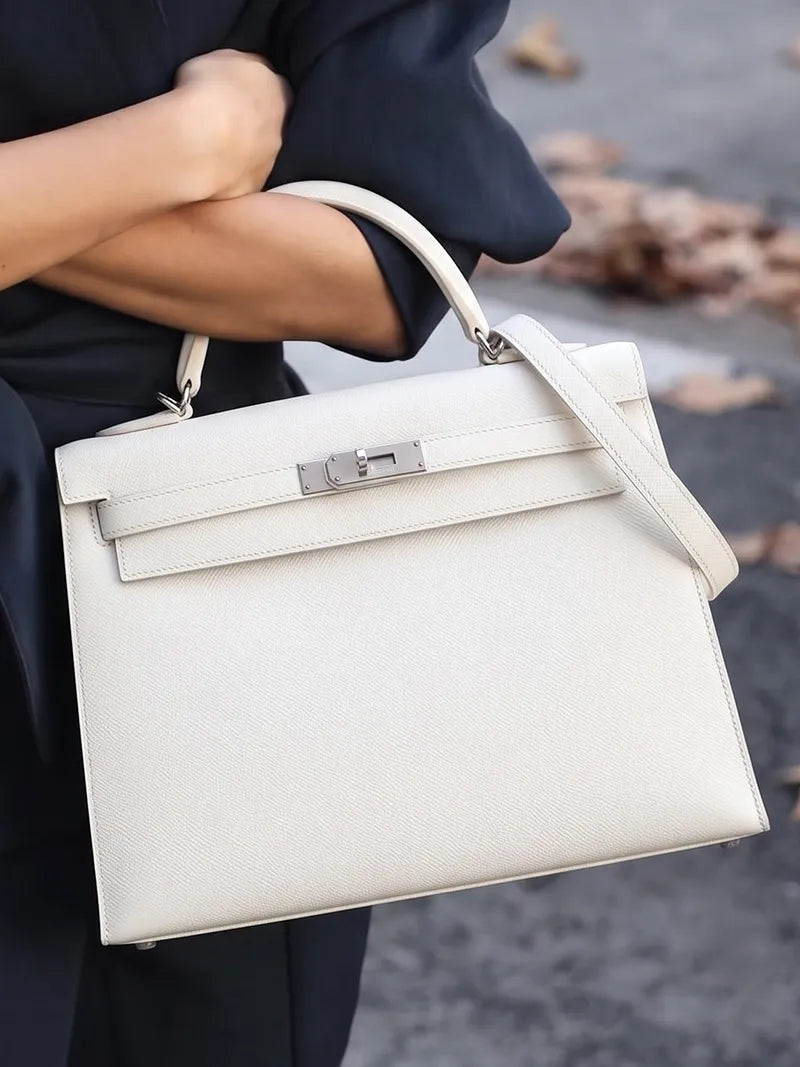
Kelly|Check the refined form and connection of parts

Kelly 25 (Sellier) Veau Epsom Black
For a Kelly, you'll want to carefully examine the connection of each part, including the trapezoidal form, handle, flap, belts, and turn lock. Check not only the front but also the sides and bottom, ensuring that the leather texture, stitching, and hardware placement are naturally consistent with the overall structure. For straps and accessories, checking them against the product description will provide peace of mind.
View Hermès Kelly product listings
Frequently Asked Questions
Q. Can I determine authenticity by the engraving alone?
A. You cannot judge by the engraving alone. The format and position vary by era, model, and specifications, and counterfeiting is possible. It's safer to consider the material, stitching, hardware, construction, and consistency with the product description, and ultimately prioritize the appraisal of a reputable seller.
Q. Is slanted stitching indicative of authenticity?
A. The angle of the stitching alone is not a criterion for authenticity. The appearance changes depending on the stitching location, leather thickness, repair history, and photographic angle, so it's better to check the flow along the outline, corners, bases, and edges comprehensively.
Q. Should I avoid pre-owned items that don't come with accessories?
A. It's not necessarily true, as the presence or absence of accessories alone cannot determine authenticity. However, practical items like straps and keys, and items that can affect appraisal like boxes and purchase records, are important, so it's crucial to confirm if the content and price are satisfactory.
Q. Can I distinguish an authentic item solely from online photos?
A. Photos can be a reference, but information such as feel, weight, hardware movement, smell, and internal structure cannot be confirmed. It's realistic not to make a definitive judgment based solely on images, but to check for additional explanations, and the seller's appraisal, warranty, and return conditions.
Summary
When choosing a pre-owned Hermès bag, the engravings, material, stitching, and hardware are crucial points to check. However, avoid concluding it's fake if just one detail differs from a typical example, or believing it's authentic just because one detail matches.
To minimize mistakes, check the bag's overall consistency, the individual item's condition, the product description, and additional photos in order, and choose a seller with a clear appraisal system and post-purchase support. Both confidence in authenticity and whether the item is in a condition for long-term use contribute to purchase satisfaction.
ALAMODE publishes photos and product information for each Hermès bag. Please compare the material, color, hardware, engravings, and condition to find a piece that you are satisfied with.
View Hermès Birkin product listings
View Hermès Kelly product listings
See other articles about Hermès
Where to Buy Hermès in Shibuya
ORANGE BOUTIQUE Shibuya

1F Saint Louis Building, 26-3 Udagawacho, Shibuya-ku, Tokyo 150-0042
Hours: 12:30–21:00 (Closed: January 1)
TEL: 03-5990-4745
Where to Buy Hermès in Aoyama & Omotesando
ORANGE BOUTIQUE Aoyama

HOLON-R 1F, 3-12-12 Kita-Aoyama, Minato-ku, Tokyo 107-0061
Hours: 11:30–20:00 (Closed: January 1)
TEL: 03-4330-0779